
Camino de Santiago: complete route guide, stages and practical tips
Strategies, tips and useful information for tackling the Camino de Santiago: find out the main routes, how many km to do, where to sleep and how best to organize your trip.
The Camino de Santiago is one of the most fascinating and transformative routes in the world. Every year thousands of people walk it for spiritual, personal reasons or simply for the desire to challenge themselves. But how is it really organized? And which route to choose? In this guide you will find all the answers.
The Camino de Santiago is one of Europe's oldest and most fascinating pilgrimages, an experience that combines spirituality, history and adventure through breathtaking landscapes.
Every year, hundreds of thousands of pilgrims from all over the world travel the various routes to Santiago de Compostela in Galicia.
What is the Camino de Santiago and what does it consist of?
The Camino de Santiago is a network of routes that cross Europe and lead to Santiago de Compostela, Spain. There is not just one route, but several paths that converge toward the same destination.
The journey is generally on foot, divided into daily stages, and is accessible to anyone with a minimum of physical fitness.
What does the pilgrimage to Santiago represent and teach?
The Santiago de Compostela pilgrimage is not just a physical journey, but an inner experience that changes the way the journey itself is experienced. What matters is not so much the final destination, but the continuity of the journey and the pace at which one takes it.
A number of key lessons emerge naturally along the way: resilience, which is necessary to cope with long and variable stages; essentiality, which leads to reducing everything to what is really useful; a greater connection with oneself, fostered by the steady pace of the walk; and anopenness to others, which arises spontaneously by sharing the same experience with other pilgrims.
Camino de Santiago: symbols and significance of the route
The Way of St. James is not just an itinerary, but a spiritual journey full of symbols and meanings that accompany each step.
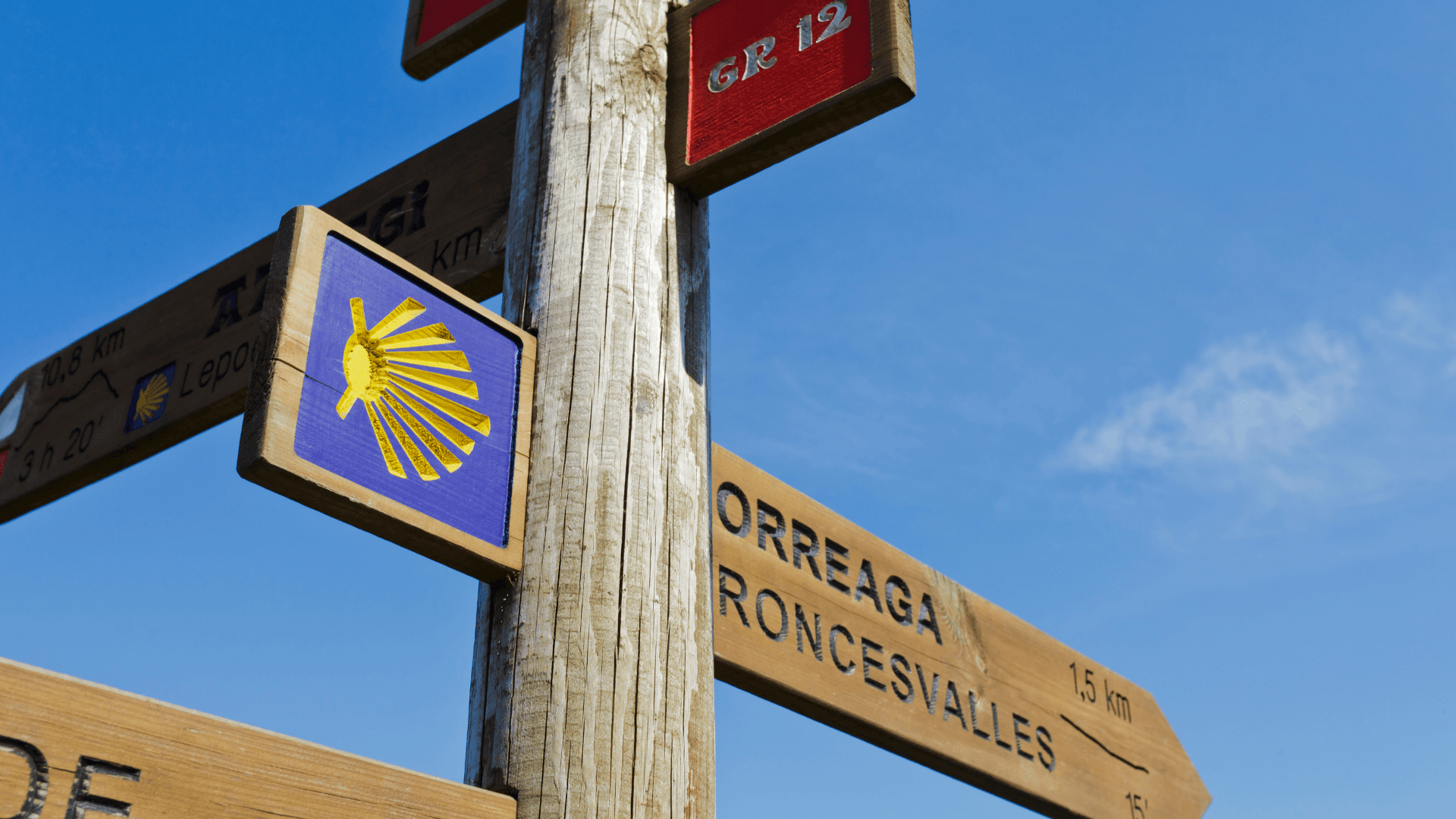
Why is the shell the symbol of the Way?
The conch shell is the most recognizable symbol of the Camino de Santiago and accompanies pilgrims along the entire route. It is not only a symbolic element, but also a practical one: it is used to indicate the direction to follow.
Its lines converge to a single point, representing the different paths leading to Santiago.
What is the spiritual and esoteric significance of the path?
For many, the Way of St. James also has a spiritual significance, related to the idea of personal quest, passage, and transformation.
Beyond the religious aspect, it is often experienced as a time of change, in which to leave room for reflection and a more essential way of traveling.
However, it is not necessary to set out with a specific spiritual motivation: often the desire to break away from routine, challenge oneself and experience something different from the usual is enough.

Camino de Santiago: main routes and where to start
Those who decide to go can choose from several routes, each with specific stages and characteristics.
What are the main Santiago de Compostela routes?
Most famous:
- French Way: the most popular
- Portuguese Way: ideal for those seeking a more accessible route
- Northern Way: scenic but challenging
- Primitive Path: the oldest and most difficult
👉 If you are considering the Portuguese Way, Porto is one of the main starting points.
Discover the facilities available here.
Where does the Way begin and end?
The beauty of the Camino de Santiago is that there is no single starting point. You can start from different European countries or choose shorter routes, depending on your time.
Many travelers opt for cities like Sarria or Porto, which allow them to experience a significant section of the route even with only a few days to spare.
Camino de Santiago km: length, stages and difficulty
The length of the Camino de Santiago varies greatly by route and is one of the first aspects to consider.
How many kilometers long is the complete Camino de Santiago?
The Camino de Santiago varies depending on the route:
- French: about 800 km
- Portuguese: 250-600 km
- North: about 825 km
How many days does it take to travel it?
It depends on the pace, but on average:
- 30-35 days for the French Way
- 10-20 days for shorter routes
How many miles a day do you need to do?
On average, about 20-25 km per day are covered during the Camino de Santiago, although this figure may vary depending on the route chosen, physical fitness and the altitude difference of the stages.
To obtain the Compostela, the certificate issued upon arrival in Santiago, it is necessary to walk at least 100 km or bike at least 200 km.
Pilgrim's Way to Santiago: how to orient and organize yourself
Understanding how to navigate along the route is one of the key aspects of approaching the Camino with peace of mind.
How to find the way?
One of the most reassuring aspects of the Camino de Santiago is the signage. The route is very well marked with yellow arrows, shells and official signs.
Despite this, many travelers also use apps or offline maps for added safety, especially in less-traveled sections.

Where do you sleep and what do you eat?
During the Santiago de Compostela pilgrimage, the range of accommodations is varied and suitable for all needs. Pilgrim hostels are the most popular option, but there is no shortage of guesthouses and small hotels.
Food is also part of the experience: simple, designed for walkers and perfect for recovering energy. The classic "pilgrim's menu" is inexpensive and complete, full of local dishes that echo traditional Spanish and Portuguese cuisine, becoming a fundamental part of the overall experience of the walk.
How to do the Camino de Santiago starting from Italy
It is also possible to start the Camino de Santiago from Italy by connecting to European routes. However, many travelers prefer to simplify the organization by choosing a starting point in Spain or Portugal.
The choice depends mainly on:
- time available
- level of preparation
- type of experience you want to have
Camino de Santiago: what it feels like at the end of the journey
Getting to Santiago is not just a geographical destination, but the result of a journey made day after day.
The most common feeling is a combination of satisfaction, lightness and awareness. Many pilgrims tell of feeling changed, even in small things. It is hard to explain in words, but easy to recognize when you experience it.
And all along the way, one phrase accompanies every encounter:
"Buen Camino."
After the Camino de Santiago: turn arrival into a relaxing experience
Getting to Santiago is an important goal. But often, after the Camino de Santiago, another need arises: to stop, rest, and give oneself a few days of comfort after so much distance traveled.
If you are considering the Portuguese Way, Porto is one of the key cities on the route and is also an ideal place to add a relaxing interlude to your trip before or after your departure.
Discover Hotiday in Porto
And if this article has ignited your desire to go away, but in a more wellness-oriented formula, Hotiday is waiting for you with selected rooms in selected facilities between sea, lake, mountain and city.
Explore all the destinations and get inspired.